
Several months ago, a group of friends and I began a quote board. Each time one of us said something particularly out of pocket, extra, or unhinged (I’ve provided links to definitions of these words for members of an older generation who may be confused by the slang), a friend would add it to the quote board.
I was inspired to write this article by something that I apparently said several weeks ago: “you could kidnap a sandwich.”
What did I mean by this? Who was I talking to, and what were we talking about? Did anyone agree with me? I will never know these things.
But I must know about the validity of my claim. How rigid is the definition of kidnap? Where does kidnapping end and petty theft begin? Kidnapping can refer to adults, not just kids. Are there other things that can be kidnapped? Can you kidnap a sandwich? I did the research so you don’t have to.
Definition
According to Merriam-Webster, the definition of kidnap is “to seize and detain or carry away by unlawful force or fraud and often with a demand for ransom.” So far, so good. This definition does not mention what kind of thing is being seized, so a sandwich is fair game.
This, however, feels like a technicality as all the examples given involved a person being kidnapped. Not to mention, the definitions on Britannica, the Cambridge Dictionary, Collins Dictionary, Vocabulary.com, and even U.S. federal law all reference a person being kidnapped.
None of these sources, however, specify that a child must be the one abducted. Adults are fair game for kidnapping. Was this true from the outset or did the usage expand over time?
Origins
Kidnap is a verb. It is a compound word, deriving from the words kid and nap.
A kid is traditionally a young goat and is descended from a Proto-Germanic source. It entered the English lexicon in some form around the year 1200, but we have been using it to reference a human child for 200-400 years.
Nap, I think, is more intriguing. It likely comes from medieval Scandinavia, evidenced by the modern Norwegian word nappe and the Swedish word nappa, which mean to catch or snatch, as well as the Danish word nappe, which means to pinch or pull.
We can see kidnap’s literal formation as a synonym for “child-snatch.”
You may be asking yourself, “what is this usage of nap? That word only means sleep to me.” That’s what I thought too! What I find fascinating is that it has evolved into the word “nab,” meaning to grab, seize, or arrest.
It turns out that kidnap is the only surviving usage of the devious medieval word nap.
First Uses
The consensus on the internet seems to be that the word kidnap arose in the 1680s among the thief community, who were already slangily referred to as nappers.
Side Note: When it originated, the word kidnap was considered a thieves’ cant, or a specific set of words that are deliberately meant to confuse outside listeners. The thieves’ cant is specific to English-speaking countries, but other secret languages can be found all over the world. Some notable translations of the thieves’ cant are:
- Boozing ken — alehouse
- Darkmans — night
- Glymmer — fire
- Bung — purse
- Cuttle-bung — a knife with a curved blade
In my opinion, all of these words deserve to be brought back into common parlance.
Unfortunately, kidnapping didn’t seem to refer to young goats. Kidnapping specifically arose when people would abduct children to work on plantations in the American colonies… Yikes.
Somehow, that’s darker than I was anticipating when starting my research on this disturbing subject.
According to WordHistories.net, the earliest known example of this word being printed comes from a dictionary1 published in 1676 in which it purported that a kidnapper was “a stealer or enticer away of Children, &c.”
Meanwhile, the earliest known regular usage of the term comes from chronicler Narcissus Luttrell who, in 1682, wrote of “a tryall at the kings bench barr upon an indictment against Mr. John Wilmore, for spiriting or kidnapping away a young boy under the age of 13 years, called Richard Siviter, and sending him to Jamaica…”
So, in its original usage, kidnapping signified the taking of children. There is little definitive documentation on when or why we began using it to refer to the abduction of adults, but this shift seems to have occurred around the mid-1800s. The theory of one online etymology forum user is that the word abduct didn’t gain its kidnappy meaning until 1834. We simply didn’t have a word for stealing adults in the English language and, therefore, we had to use the next closest thing: kidnap. This seems plausible to me, but what do I know?
The Types of Nappings
Throughout my inconclusive research, something had been nagging at me – what about dognapping? This word, first appearing in 1898, is directly evolved from kidnapping but contains a subtle difference in subject matter.
Is the existence of this word the exception that proves the rule? If we must clarify when dogs are napped, does that mean kidnapping can really only apply to humans and not to sandwiches?
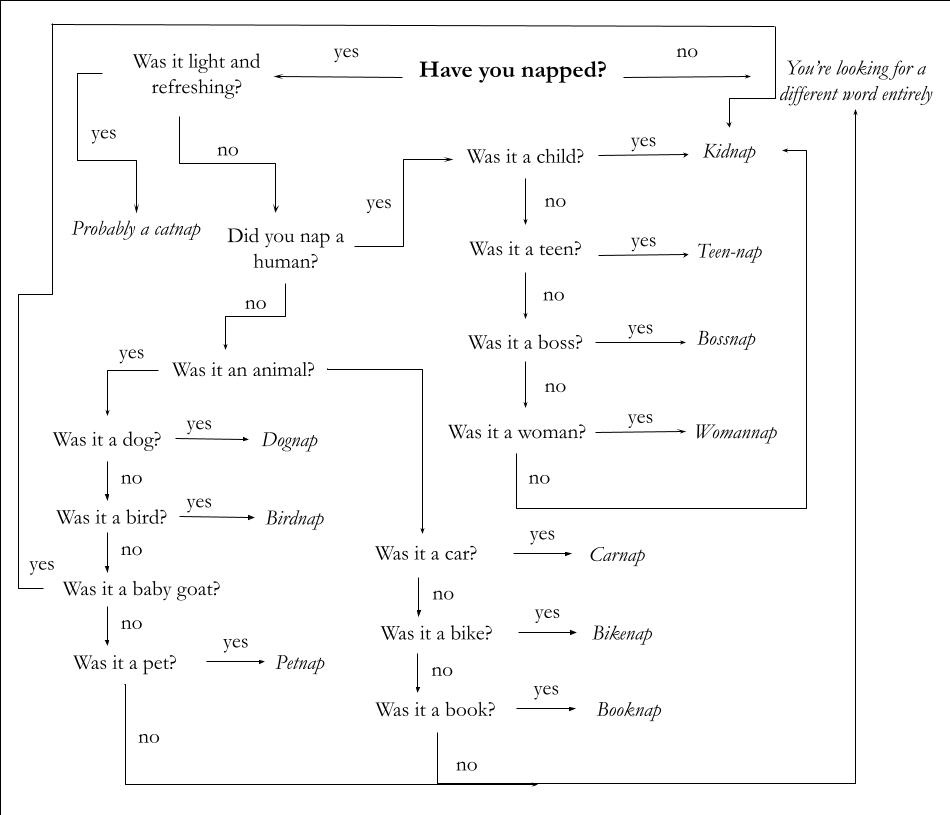
The more I looked, the less I wanted to see. It turns out the criminal underworld of nappers is far larger than I once thought. There are the animalistic petnappers, the spineless booknappers, the yellow-bellied birdnappers, all while the bikenappers peddle their ill-gotten gains. The inhumane teen-nappers, womannappers, and bossnappers might make their escape with the help of a carnapper. Don’t even get me started on the gingersnappers.
A major napper that should be kept off this list is the catnapper. Though the word originated before dognap, it uses English’s contemporary definition of the word nap as in a light rest.
In case you’re trying to keep track, you could kidnap a human of any age (and possibly a young goat), though if that human is a woman, teenager, or boss then there’s a more descriptive word. If you’ve stolen a pet, that makes you a petnapper unless that animal is a dog or bird, for which there are more descriptive words. As far as inanimate objects go, you can nap a car, bike, or book and apparently nothing else. I’ve summarized these findings in the graphic below.
In Summary
No, you cannot kidnap a sandwich. The word kidnapping is reserved for humans.
That’s All to Say
Why are we so exclusive with our “nap” suffix? The words currently utilizing it seem somewhat arbitrary to me. Can a person commit grand nap auto or be the victim of identitynapping? Plus, lovebirds might be able to nap a kiss after they napped a glance. Doesn’t that sound cuter?
This antiquated language sounds silly to my ears, but maybe using silly words is a way to add whimsy into a world that seems to have so much need for the word theft.
Notes
- This dictionary, written by Eisha Coles, has a beautifully long name:
An English Dictionary: Explaining the difficult Terms that are used in Divinity, Husbandry, Physick, Phylosophy, Law, Navigation, Mathematicks, and other Arts and Sciences. Containing Many Thousands of Hard Words (and proper names of Places) more than are in any other English Dictionary or Expositor. Together with the Etymological Derivation of them from their proper Fountains, whether Hebrew, Greek, Latin, French, or any other Language. In a Method more comprehensive, than any that is extant ↩︎
 That's All to Say
Leave a comment