
About a month ago, many of us in the Western world turned the page on 2024 and ushered in a new year. But why?
I’m not asking why we celebrate the new year as a concept. Humans have been honoring the changing seasons since the dawn of recorded history, and likely well before that. The recent observation of the Lunar New Year is one instance in a proud tradition dating back some 4,000 years; Jewish communities have been gathering for Rosh Hashanah1 for possibly over two millennia; and the earliest recorded example of humans gathering to celebrate the new year is the ancient Mesopotamian festival of Akitu where, notably, tradition dictated that Babylonian kings would be slapped hard in the face by a priest in the hopes that they cry, thus demonstrating they have divine approval.2 It seems that, whatever unique form it takes, celebration of a new year is part of our human heritage.
I want to know why we specifically observe the new year on January 1st. Most new year celebrations have a correlation with the phase of the moon and/or the Earth’s rotation around the sun: for example, on the first day of spring like in the Iranian New Year. January 1st is typically 11 days after the winter solstice3, the Northern Hemisphere’s shortest day of the year, and followers of astrology will know that the phases of the moon do not line up with the months. The date just seems so random.
In many ways, it is.
Rome and Moon
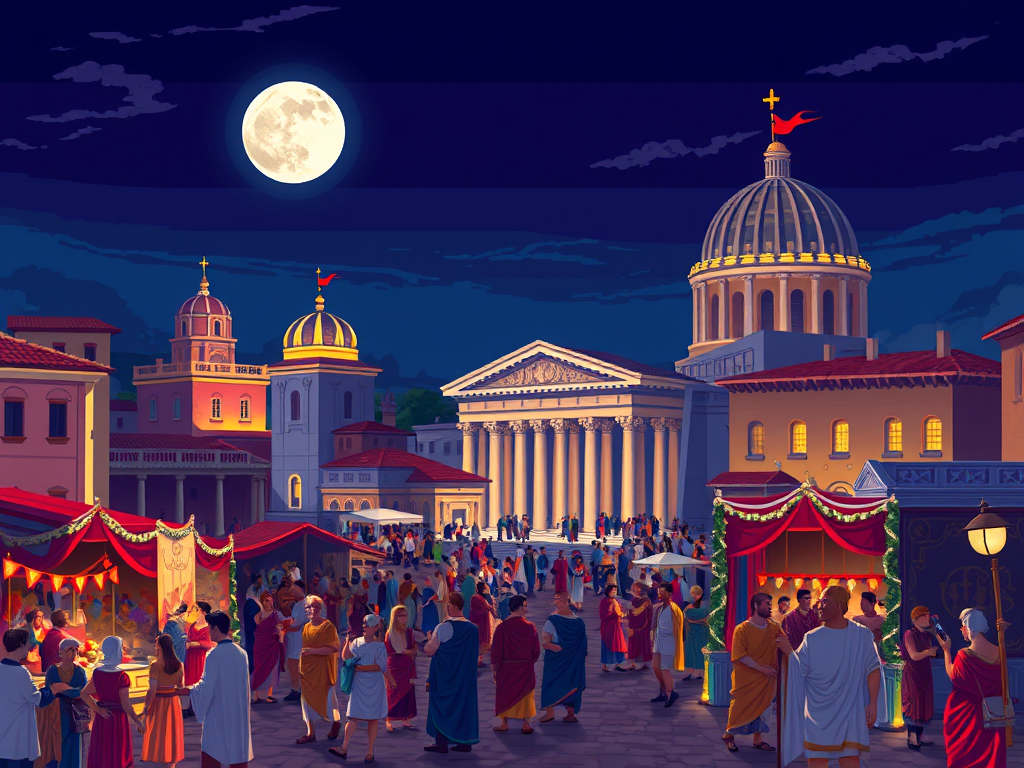
It all starts with Ancient Rome. The symbolic founder of Rome, Romulus, is said to have established the city’s original calendar system. Now, if you were a mythological king in the 8th century BCE with no knowledge of Earth’s astronomic relationship to the sun and you were tasked with creating a way of dividing the days into accessible groups each year, how would you do it? My guess is you’d do what Romulus decided: use the moon. The calendar used by the Roman Kingdom and Roman Republic was a lunar calendar.
In the beginning, it had 10 months. The first day of the month occurred on the new moon4 and is known as the Kalendae (anglicized to Kalends and the origin of the word “Calendar”). The full moon generally occurred in the middle of the month known as the Idus (anglicized to Ides).
Side note: The Roman calendar began with the month of “Martius,” named after the war-god Mars (presumably because the military campaign season began in the spring) and the namesake for our March. The following months will look familiar, being Aprilis, Maius, and Junius. For the fifth month, the Romans ran out of fun ideas for month names and resorted to numbering them. The fifth month Quintilis is based on the Latin number five, quinque. Thus it is followed by Sextilis, September, October, November, and December.
The moon completes a cycle every 29.5 days. To account for this imperfect fit, the Romans added an extra day to the months of March, April, May, Quintilis, and October. Because they double-counted a new moon as the last day of one month and the first day of the next, we begin to see the basis for the 30- or 31-day months we have today. There were a total of 304 days named in their calendar, but it only spanned 295 days of the year.
The 10-month calendar seems to have been heavily related to agriculture. The year began in the growing season in March and ended after the harvest in December. The remaining wintery days of the year were placed in an unclassified chunk of time. To be honest, considering the winter to be a nebulous limbo period sounds appropriate to me.
The Problem with the Moon

Unfortunately, the Romans eventually tired of ending their year with such uncertainty. Two months consisting of 28 days each, Januarius and Februarius, were added to the end of the calendar to account for the winter and every month that had 30 days was reduced to 29. This leaves us with a complete lunar calendar that aligns with all 12 complete lunar cycles within a year accounting for 354 days—approximately 11 days out of sync with the Earth’s rotation around the sun.
Aha! The Roman calendar was 11 days out of sync with the solar year and our New Year’s Day is 11 days after the winter solstice. Could this be the start of our explanation? Actually, no. It’s likely just a coincidence. For one, because an extra day was added to January for superstitious reasons making it a total of 29 days and, more importantly, the solstice and lunar phases are not correlated.
To counter the problem of gaining a little over 10 days each year, the Romans did something beautifully simple. They divided the years into groups of four, and every two years and added a bonus, “intercalary” month in between February 23rd. The intercalary month lasted 22 days in the second year and 23 days in the fourth year. Once it ended, February would resume on the 24th. Sorry, did I say beautifully simple? I meant beautifully contrived and convoluted.
How Spain Changed the World
I know that this has been a dense piece of writing, but I promise we’re close to the answer. Here’s the important part to remember so far: the Roman Republic used a lunar calendar with 12 months in a year where the months began on the new moon, or the Kalends.
As I mentioned earlier, the first month of the year was March, and March began on a new moon. But in Roman civic life, they marked the start of the new year when new consuls (the Republic’s most important politicians) began their annual term on the Ides of March, which occurred on the 15th day of the month when there was a full moon.
We have the Spaniards to thank for motivating the change to January 1st. For, in 154 BCE, Celtic tribes on the Iberian Peninsula rebelled, sparking the Second Celtiberian War. At this time in Rome, political and military positions were deeply intertwined. A Roman named Quintus Fulvius Nobilior was set to assume his consulship on the Ides of March the following year, and as such would need to command his army to put down the rebellion.
The Senate decreed that, in order to allow Nobilior to get a head start on the military campaign, the consulship would begin on the Kalends of January, or January 1st. Consuls served one-year terms and, so, this date endured as the beginning of the Roman civil calendar henceforth. Unfortunately, using January as the first month is also why the names of September, October, November, and December do not match their respective placement in the year.
So there we have it, the bulk of our answer. There are just a few loose ends to tie up. For example, why don’t we use the new moon to mark our new year? In fact, our calendar has nothing to do with the moon, and yet we still use the Roman-prescribed Kalends of January as the start of our year.
Caesar and the Sun

To answer this, we have to go back to the problem of inserting extra days in the middle of February. While this was a theoretically sound way to fit a lunar-based calendar in the solar year, one key problem was that it was not automatic. These additional months were added at the discretion of the pontifex maximus, or high priest, who was meant to announce in February whether there would be an intercalary period based on whether it fit with the sun, moon, and seasons.
Throughout Rome’s history, the pontifex maximus became an increasingly politicized position. Because the additional days were considered unlucky, intercalation was often ignored during war, or the pontifex maximus would decide whether to add extra days based on whether their friends were in office that year. The system wasn’t really working as planned.
Enter Julius Caesar.
Rather, exit Julius Caesar. He served as pontifex maximus from 63-44 BCE and he spent most of those 19 years conquering lands for Rome or fighting a civil war against it. In other words, he was largely unable to be in Rome to announce another intercalary month for quite some time. By 46 BCE, the calendar was several months out of sync with the seasons and Caesar decided to fix the issue once and for all.
The following year, Caesar was the new dictator of Rome and sought the advice of an astronomer named Sosigenes to make a new solar calendar. They devised a system that covered 365.25 days in a year, but maintained the names of the months (except Quitilis and Sextilis would later be renamed for Julius Caesar and Augustus, the first Emperor of Rome, giving us July and August).
Side Note: Because the Roman calendar was about three months ahead of the solar year by the time Caesar reformed it, more days had to be inserted into the year 46 BCE in order to get it realigned with the seasons. That year had 445 total days.
Critically, the Julian calendar maintained January 1st as the beginning of the year. It also added a leap day every four years, but the leap day occurred within the traditional placement of the original intercalary periods. That is, after February 23rd.
Again, we are so close to the full picture, though our work is not done because the winter solstice was calculated to be December 25th. How did we shift four days to our current calendar where the solstice happens on the 21st?
How Easter Changed the World

The issue comes down to the fact that Sosigenes had used a slightly incorrect calculation of the number of days in a year. Rather than 365.25 days in a year, as the Julian calendar assumed, a solar year lasts 365.24217 days. It may seem minute, but the Julian calendar was just over 11 minutes longer than the Earth’s full revolution around the sun. Every 128th year, the date would be one day earlier than it should be.
In the 4th century CE, a controversy in the Catholic Church inspired Christian leaders to set a new official computation for when Easter should occur at the First Council of Nicaea. They did not actually agree on when that should be, just that Christians everywhere need to agree on a new date.
While the history of the Christian world agreeing on a date for Easter could make another interesting article, what’s important to my query is that the spring equinox (the day that the sun perfectly spans the Earth’s equator, or halfway between the solstices) is critical to determining the date of Easter and that the spring equinox at the time of the First Council of Nicaea was on March 21 because of the compounding inaccuracy of the Julian calendar.
Fast forward 12 centuries and that rounding error was getting worse. The spring equinox in the 1580s was March 11th.
Enter Pope Gregory XIII.
Unlike Caesar during his term as pontifex maximus, the pope was in Rome and ready to make some reforms. For our purposes, he did two important things: he improved the rounding error5 and he realigned the calendar so that the spring equinox always occurs between March 19th and March 21st. To do this, in the year 1582, October 4th was immediately October 15th. So if you ever have the need to make up some historical event, just say that it happened on October 5th, 1582!6
So there you have it. The new year was now relatively fixed on January 1st so that the spring equinox occurred sometime a little after mid-March. The Gregorian calendar was slowly adopted by most of the world and now many people in the United States stand outside in the cold to watch a glowing ball slowly descend down a pipe every year.
In Summary
We celebrate New Year’s Day on January 1st because the Roman Republic defined their years by the terms of their government officials. In 154 BCE, they set January 1st as the day the new term began because there was an ongoing rebellion in Spain that needed attention and it would give time for the leaders to prepare before the military campaign season kicked off in the spring.
It was not arbitrary. At that time, the Roman calendar used new moons as the start of their month. Once Julius Caesar took power and introduced a solar calendar, January 1st remained the start of the year, but it lost its correlation with the phases of the moon. The original Julian calendar set the spring equinox at March 25 and the winter solstice at December 25.
The Julian calendar’s calculations of a year were imprecise and, in 325 CE, the spring equinox was occurring on March 21st. The timing of Easter is dependent on the date of the spring equinox and Christian leaders of the day met to propose changing when Easter was celebrated, but they made relevant reforms.
In 1582, Pope Gregory XIII wanted to fix the issue of the spring equinox slowly drifting earlier (it was occurring on March 11 by then), so that it would maintain its date when the Christian leaders met in 325. He shifted the days forward and reformed our leap days so that the spring equinox will always happen on March 19th-21st.
That’s All to Say:
There’s no good reason that our year has to start on January first. If, like me, you belong to a Christmas-celebrating U.S. household, you might also feel as though the last months of the year are a whirlwind of activity.
As the fall is underway, you might prepare for a Halloween party, decorate your yard, and find costumes for you kids. Less than a month later, millions of Americans prepare to journey home for Thanksgiving, one of the busiest travel periods of the year. Less than a month after that, we’re already buying Christmas presents. After about 6 days, hooray! Three, two, one, Happy New Year!
The tempo is exhausting.
What’s worse: most people just go back to work in that first week of January, girding their psyche for the dark, cold months that begin our year. Until about March, there’s nothing to look forward to, nothing to anticipate. The celebration of January’s and February’s two total federal holidays pales in comparison to those of their preceding three months.
I submit: it doesn’t have to be this way. The calendar has been changed before and it can be changed again. There are peoples all over the world that do not use the Gregorian calendar and they’re living their lives just fine. We date our year by a ham-fisted attempt to convert a lunar calendar into a solar calendar and a compromise about a miscalculated leap day. If our calendar is based on the Earth’s revolution around the sun, let’s commit.
Here are my two proposals:
- Do as the Romans did
Let’s begin our year on the spring equinox. It is a time when the world is coming alive again. Leaves are blooming, snow is melting, birds are chirping. At what point do you honestly feel like a new year has begun: when you count to ten and pop champagne or when you go outside, feel the sun on your face, and smell new life in the breeze? As an added bonus, the names of September, October, November, and December would make sense again. - The spirit of the law
If you read about the original Roman lunar calendar and footnote #4, you’ll remember that the Romans marked a new month when the first sliver of lunar light was visible after a new moon. In the spirit of this tradition, we could also start our new year on the day after the winter solstice. It’s very logical: the days have ceased their shortening and henceforth the light will return.
Both of these proposals will preferably include adding or skipping a few days from our current calendar in order to make them align with the beginning of the month. They are also heavily biased toward the Northern Hemisphere, but about 90 percent of humans live in the Northern Hemisphere so I’m comfortable with the trade.
If I had my druthers, it would be the spring equinox. If the trees counted their years, they would start in the spring.
Tradition is not a good enough reason to avoid change. Neither is hassle.
I’ll end with Marcus Aurelius: “Nature which governs the whole will soon change all things which you see, and out of their substance will make other things and again other things… in order that the world may be ever new.”
He also said it more succinctly: “Nothing that is according to nature can be evil.”
Notes
- Rosh Hashanah is not simply a changing of calendars like New Year’s Day in the West. To learn more, I recommend this article from HISTORY.com ↩︎
- For more reading on all of these storied traditions, I recommend this article. ↩︎
- I’ll use the terms “winter solstice” and “spring equinox” in relation to the Northern Hemisphere. A more accurate name would be the liberal solstice and vernal equinox, respectively. ↩︎
- The Kalends may have actually been when the first sliver of the moon could be visible after the new moon, but saying new moon is simpler, so I’m going to use that. ↩︎
- There is now a leap day every four years, except for years divisible by 100, but years divisible by 400 do have a leap day. ↩︎
- Adoption of this calendar varied across the world, so maybe that isn’t that clever. ↩︎
 That's All to Say
Leave a comment